Ollantaytambo is one of the most remarkable places in Peru. Families still live inside walls built by the Incas more than 500 years ago. Water still runs through stone channels along the streets. Above town, giant terraces climb the mountainside toward a temple of pink granite.
Most travelers pass through Ollantaytambo to catch the train to Machu Picchu. Yet the town deserves a slower visit. In this guide, you’ll learn what to see in Ollantaytambo, how to plan your visit and why it’s often called a living Inca town. You’ll also see how it fits into a guided trip with Good Life Expeditions.
Why Ollantaytambo Is Called a Living Inca Town
Ollantaytambo sits at about 9,160 feet (2,792 meters) at the western end of the Sacred Valley. It’s lower than Cusco, so many travelers find the air easier here.
The old part of town keeps its Inca layout. Narrow stone streets form a grid of blocks called canchas. Each block once held several homes around a shared courtyard. Today, local families still use many of these spaces. Walk slowly, keep your voice low and ask before taking photos of people or their homes.
The town also played a key role in history. In the 1530s, the Inca leader Manco Inca made a stand here against Spanish forces. His troops used the terraces and the river to hold them off for a time.
What to See in Ollantaytambo
The archaeological complex
The ruins rise right above the main square. A long stairway of stone steps climbs past wide agricultural terraces. The views of the valley grow better with every level.
At the top, you’ll find the Temple of the Sun. Its wall of six huge pink granite blocks is one of the finest examples of Inca stonework. The stones were carried from a quarry on the other side of the river. How the Incas moved them is still a source of wonder.
Nearby, look for the Enclosure of the Ten Niches and the ceremonial baths. Each one shows how the Incas blended stone, water and landscape.
Pinkuylluna
Across town, on the opposite mountain, stand a group of Inca storehouses. The Incas built them high up, where cool winds helped preserve food. A steep path leads up to them. The climb is short but demanding, and the view of the town and ruins is worth it.
The town itself
Some of the best moments in Ollantaytambo come from simply wandering. Follow the water channels. Peek into a courtyard. Sit in the plaza and watch daily life. The town feels calm in the early morning and late afternoon, when day visitors are gone.
For more ideas across the valley, read our guide to hiking in the Sacred Valley.
Tips for Visiting Ollantaytambo
- Take your time on the stairs. The climb to the top of the ruins is steep. Go at your own pace and rest along the way.
- Bring layers and sun protection. Mornings can be cool, and the midday sun is strong.
- Plan for the season. The dry season runs from about May to October. Rain is more common from November to March. Our guide to the best time to visit Peru has more detail.
- Support local businesses. Buy crafts from local artisans and eat at family-run restaurants.
Ollantaytambo and the train to Machu Picchu
Ollantaytambo is the main departure point for trains to Machu Picchu. Many travelers explore the ruins in the morning and board the train in the afternoon. Our guide to the train to Machu Picchu explains how the route works.
How Ollantaytambo Fits Into Our Tours
Ollantaytambo is part of both of our active tours.
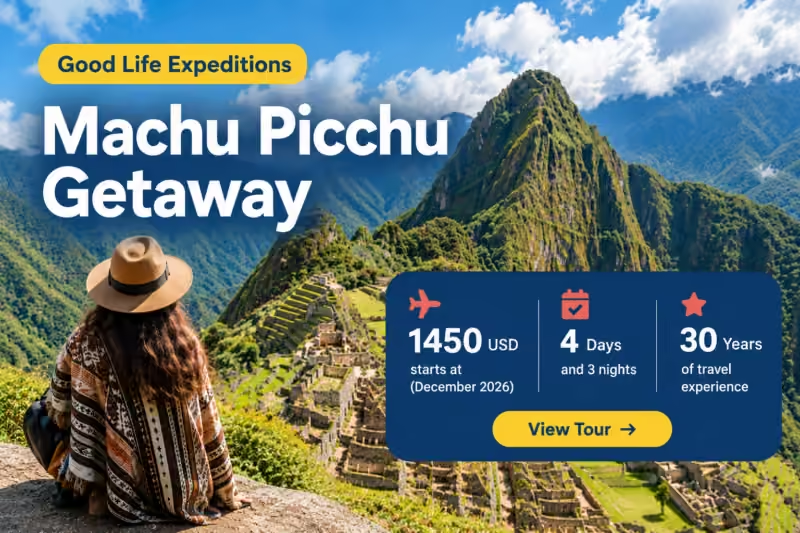
On the Machu Picchu Getaway and Classic Peru, your Sacred Valley day ends here. You’ll choose between two routes. One visits Maras and Moray first. The other visits Pisac. Both finish with a guided walk up the terraces of Ollantaytambo. Then you’ll board an afternoon train to Aguas Calientes.
Your guide, transport and entrance tickets are included. On the way back from Machu Picchu, your driver meets you at Ollantaytambo station for a private transfer to Cusco.
Good Life Expeditions is the travel brand of MEDLIFE. A part of what you invest in your trip stays in Peru and helps fund MEDLIFE’s projects in local communities.
FAQ: Ollantaytambo
Is Ollantaytambo worth visiting?
Yes. Its Inca ruins are some of the most impressive in the Sacred Valley. The town itself is a rare chance to walk through streets still shaped by Inca design.
How long do you need in Ollantaytambo?
A half day covers the main ruins and a walk through town. With a full day, you can add Pinkuylluna and enjoy a slower pace.
How high is Ollantaytambo?
Ollantaytambo sits at about 9,160 feet (2,792 meters). That’s lower than Cusco, which sits at about 11,150 feet (3,400 meters).
Walk Through Living History
Few places let you step so directly into the past. In Ollantaytambo, Inca history is part of everyday life. Let us plan your trip, so you can explore the valley with a local expert by your side.
Contact our team for a personalized plan.