Most people know Machu Picchu from photos. Fewer know the stories hidden in its stones, its terraces and the forest around it. Some of the best Machu Picchu facts are the ones guides share on the spot, standing in front of a wall or a carved rock.
In this guide, you’ll discover surprising Machu Picchu facts about how it was built, how it was used and what lives there today. You’ll learn about its engineering, its link to the sun and the stars, and its rich nature. These details will help you see the citadel with new eyes when you visit.
Machu Picchu Facts About Its History
It was never truly lost
Machu Picchu is often called the “Lost City of the Incas.” Local families always knew it was there. Some even farmed its terraces. Hiram Bingham brought it to international fame in 1911, guided by local farmers.
Its name may not be original
“Machu Picchu” means “old mountain” in Quechua. Some historians believe the Inca knew the site by another name. Old documents suggest it may have been called simply “Picchu.”
It was used for only about a century
The Inca built it in the 1400s and left it around the time of the Spanish conquest. That short life is part of why it survived so well. Learn more in our guide to Machu Picchu’s elevation and setting.
It was a royal retreat
Many historians believe it was an estate for the Inca ruler Pachacuti and the nobility. It combined homes, temples, workshops and farmland.
Machu Picchu Facts About Its Engineering
Much of the work is underground
The site gets a lot of rain. To keep it from sliding off the mountain, the Inca built deep foundations and layers of stone and gravel for drainage. A large part of the construction is hidden below the surface.
The walls were built for earthquakes
The finest walls have no mortar. The stones fit so tightly that they move slightly in an earthquake and then settle back. Doors and windows are trapezoidal, which adds strength.
The terraces did more than grow food
The terraces created farmland on steep slopes. They also controlled erosion and helped water drain safely.
There’s a quarry inside the site
Builders cut much of the granite on site. You can still see a rocky area where stone was worked.
Machu Picchu Facts About the Sun, the Stars and Nature
Some buildings follow the sun
The Temple of the Sun has a window that lines up with the sunrise on the June solstice. The Inca carefully tracked the sun to guide farming and ceremonies.
The Intihuatana stone is a mystery
This carved granite stone is one of the most famous objects at the site. Its name is often translated as “hitching post of the sun.” Its exact purpose is still debated.
It’s a natural sanctuary too
Machu Picchu is a UNESCO World Heritage Site for both its culture and its nature. The surrounding cloud forest is home to many orchids, colorful birds and even the rare spectacled bear. Sightings depend on luck and season.
Llamas live there
A small group of llamas grazes on the terraces. They help keep the grass short, and they’re happy to pose for photos.
It has strict daily limits
To protect the site, visitor numbers are controlled with timed tickets and set routes. Our guide to Machu Picchu circuits explains how they work.
Hear These Stories With a Local Guide
Machu Picchu facts come alive when someone shows you the details in person. On our tours, a local expert guide points out the hidden stories in each wall and terrace.
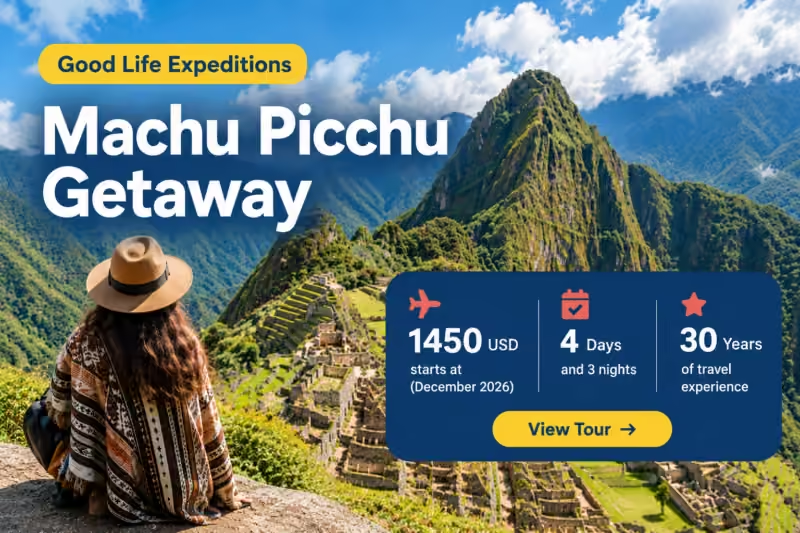
Our Machu Picchu Getaway and Classic Peru tours include your entry ticket, train, bus and guide. You’ll spend the night in Aguas Calientes and visit early the next morning.
Good Life Expeditions is the travel brand of MEDLIFE. A part of what you invest in your trip stays in Peru and helps fund MEDLIFE’s projects in local communities. Curious about traveling this way? Learn what impact travel is.
FAQ: Machu Picchu Facts
What does Machu Picchu mean?
Machu Picchu means “old mountain” in Quechua, the language of the Inca.
Why is Machu Picchu so famous?
It’s one of the best-preserved Inca sites, with amazing engineering and a dramatic mountain setting.
Is Machu Picchu one of the Seven Wonders?
Yes. In 2007, it was named one of the New Seven Wonders of the World in a global vote.
See the Stories for Yourself
Every wall at Machu Picchu has a story. Some are written in stone, and others live in the forest around it. Let us plan your visit, so you can discover them in person.
Contact our team to plan your Machu Picchu trip.